
Dr. Nikolaos M. Matzakos
Email • PhD in Mathematics, NTUA
Mathematics education and technology-enhanced learning, applied mathematics, data-driven modeling, machine learning
Visiting Scientist / Past member (September 2025 – June, 2026 | April 28 – 30, 2025)
ASPETE, School of Pedagogical and Technological Education
Host: Enrique Zuazua
Room 03.311 | FAU DCN-AvH, Chair for Dynamics, Control, Machine Learning and Numerics – Alexander von Humboldt Professorship
Friedrich-Alexander-Universität Erlangen-Nürnberg
Naturwissenschaftliche Fakultät. Department Mathematik
Research Gate | ORCID | Personal site | LinkedIn
I am an Associate Professor of Applied Mathematics and Artificial Intelligence in Education at the School of Pedagogical and Technological Education in Athens, Greece.
I am a visiting scientist at FAU DCN-AvH, the Chair for Dynamics, Control, Machine Learning and Numerics – Alexander von Humboldt Professorship at Friedrich-Alexander-Universität Erlangen-Nürnberg, Bavaria (Germany).
My early research focused on nonlinear analysis and differential inclusions, particularly on boundary value problems involving multivalued nonlinearities, maximal monotone operators, and hemivariational structures. In my doctoral work at the National Technical University of Athens, I studied nonlinear boundary value problems for ordinary, elliptic, and evolution differential inclusions, developing existence results using methods from nonlinear functional analysis, variational techniques, and multivalued analysis.
In later years, my research interests expanded toward mathematics education and technology-enhanced learning, with particular emphasis on the use of computational tools and digital environments in the teaching of mathematics. More recently, I have focused on the integration of generative artificial intelligence (GenAI) tools in mathematics and engineering education, exploring how large language models and AI-based assistants can support mathematical reasoning, problem solving, and inquiry-based learning. This work also examines how computer algebra systems, generative AI, and interactive digital platforms can be combined to design modern mathematics laboratory environments and technology-supported learning experiences in higher education.
More recently, my research has explored the interaction between applied mathematics, data-driven modeling, and machine learning.
In particular, I investigate the use of neural networks and neural ordinary differential equations (Neural ODEs) as emerging frameworks for modeling complex dynamical systems.
My work focuses on the mathematical properties and dynamical behavior of these models, including issues related to stability, sensitivity, and the role of model architecture and activation functions in the representation of nonlinear dynamics. This line of research aims to combine tools from dynamical systems and nonlinear analysis with modern machine learning approaches for the study and modeling of complex time-dependent phenomena.
Research interests
In later years, my research interests expanded toward mathematics education and technology-enhanced learning, with particular emphasis on the use of computational tools and digital environments in the teaching of mathematics.
More recently, I have focused on the integration of generative artificial intelligence (GenAI) tools in mathematics and engineering education, exploring how large language models and AI-based assistants can support mathematical reasoning, problem solving, and inquiry-based learning. This work also examines how computer algebra systems, generative AI, and interactive digital platforms can be combined to design modern mathematics laboratory environments and technology-supported learning experiences in higher education.
More recently, my research has explored the interaction between applied mathematics, data-driven modeling, and machine learning.
In particular, I investigate the use of neural networks and neural ordinary differential equations (Neural ODEs) as emerging frameworks for modeling complex dynamical systems.
My work focuses on the mathematical properties and dynamical behavior of these models, including issues related to stability, sensitivity, and the role of model architecture and activation functions in the representation of nonlinear dynamics.
This line of research aims to combine tools from dynamical systems and nonlinear analysis with modern machine learning approaches for the study and modeling of complex time-dependent phenomena.
Projects
Posts on Math & Research
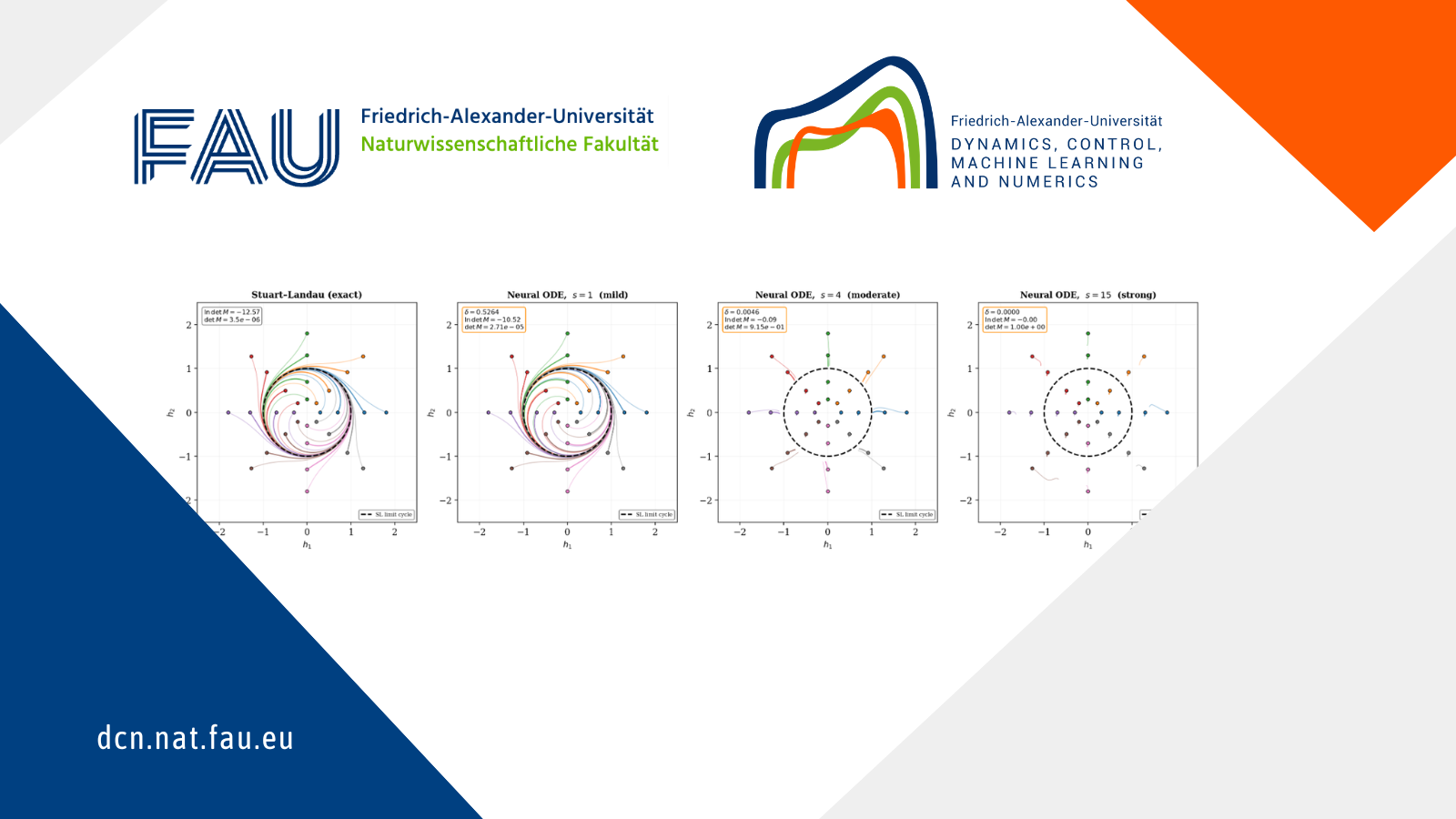
Activation Saturation and Jacobian Attenuation in Neural Ordinary Differential Equations
Authors: Nikolaos M. Matzakos
Date: May 31, 2026
See more
Publications
2027
- , :
Long-Time Trajectory Approximation via SA-NODEs: Model Predictive and Floquet Strategies
(2027)
DOI: 10.48550/arXiv.2608.10738
URL: https://arxiv.org/abs/2608.10738
BibTeX: Download
2026
- :
Activation Saturation and Floquet Spectrum Collapse in Neural ODEs
(2026)
Open Access: https://doi.org/10.48550/arXiv.2604.00543
BibTeX: Download