Mathematical Foundations of Control and Machine Learning
Master Course – FAU, Friedrich-Alexander-Universität Erlangen–Nürnberg
Date: Winter Semester 2026/2027
Course Overview
The course provides a unified mathematical perspective on control theory and machine learning. It introduces key concepts from the analysis of dynamical systems governed by ordinary and partial differential equations (ODEs and PDEs) — controllability, observability and stability — and builds on them to show how control-theoretic and optimization-based methods explain the dynamics of state-of-the-art machine learning systems: deep neural networks, federated learning frameworks, reinforcement learning and large language models (LLMs).
Instructor
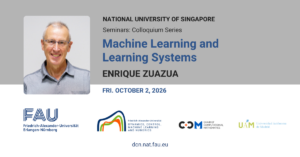
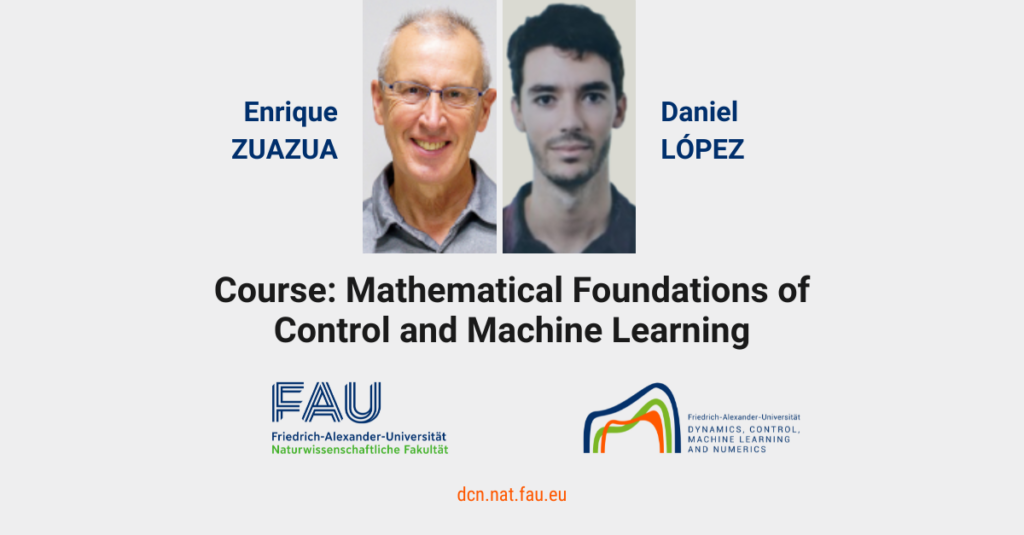
• Prof. Enrique Zuazua. FAU, Friedrich-Alexander-Universität Erlangen–Nürnberg
Teaching Assistant
• Daniel López Montero, PhD candidate at FAU DCN-AvH, Chair for Dynamics, Control, Machine Learning and Numerics – Alexander von Humboldt Professorship. Friedrich-Alexander-Universität Erlangen-Nürnberg
Learning Objectives
By the end of the course students will have developed a solid understanding of the mathematical and dynamical foundations underlying control and learning systems. They will be able to
• analyse the optimization and stability properties of deep learning algorithms,
• explain how control-theoretic principles extend to large-scale models such as LLMs,
• deliver clear and rigorous scientific presentations of technical concepts and research results.
Course Prerequisites
Students are expected to have a basic background in:
• basic knowledge of calculus,
• linear algebra,
• ODEs and PDEs.
The code is written in Python with PyTorch, but no prior exposure to either is assumed — the notebooks keep the code to the shortest fragment that illustrates the mathematics.
Course Materials
All course materials available at: https://cml-fau.github.io/mfcml/
References
- I. Goodfellow, Y. Bengio, and A. Courville, Deep Learning. MIT Press, 2016
- R. S. Sutton and A. G. Barto, Reinforcement Learning: An Introduction, 2nd ed. MIT Press, 2018
- C. F. Higham and D. J. Higham, “Deep learning: An introduction for applied mathematicians,” SIAM Review, 61(4) (2019), 860–891
- L. Bottou, F. E. Curtis, and J. Nocedal, “Optimization methods for large-scale machine learning,” SIAM Review, 60(2) (2018), 223–311
- J. Nocedal and S. J. Wright, Numerical Optimization, 2nd ed. Springer, 2006
- J.-M. Coron, Control and Nonlinearity, Mathematical Surveys and Monographs, Vol. 136. American Mathematical Society, 2007
- D. Ruiz-Balet and E. Zuazua, “Neural ODE control for classification, approximation and transport,” arXiv preprint arXiv:2104.05278, 2021
- E. Zuazua, “Propagation, observation, and control of waves approximated by finite difference methods,” SIAM Review, 47(2) (2005), 197–243
- E. Zuazua, “Controllability and observability of partial differential equations: Some results and open problems,” in Handbook of Differential Equations: Evolutionary Equations, Vol. 3, North-Holland, 2006, pp. 527–621